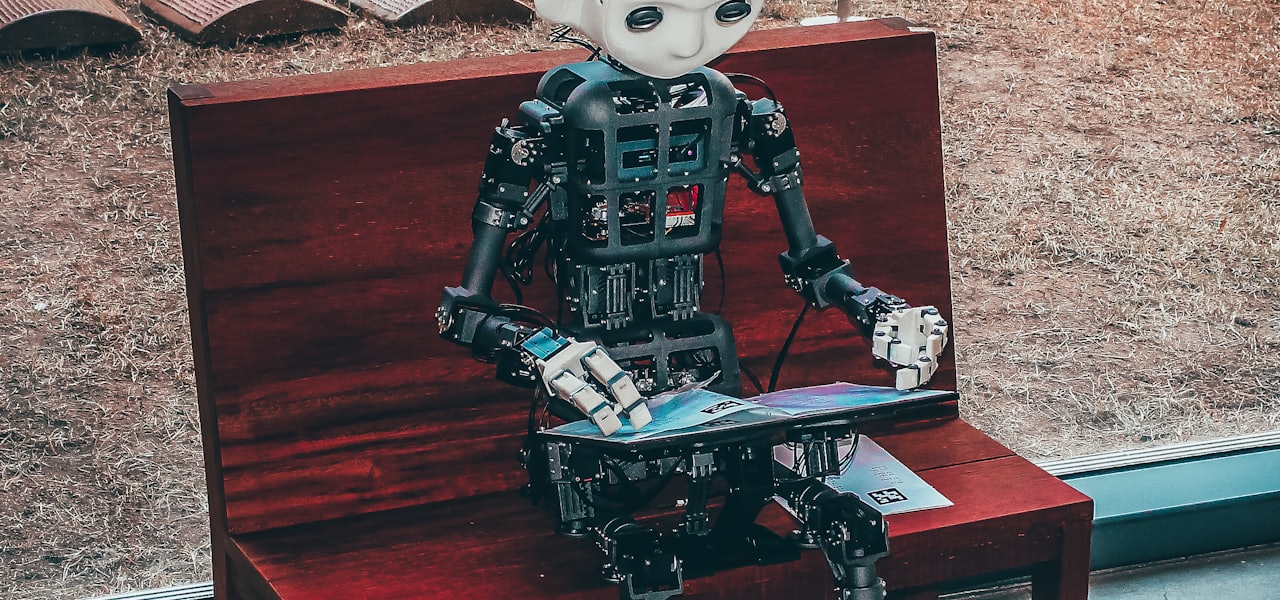
Mario Klingemann (born 1970 in Laatzen, Lower Saxony) is a German artist best known for his work involving neural networks, code, and algorithms. Klingemann was a Google Arts and Culture resident from 2016 to 2018, and he is considered as a pioneer in the use of computer learning in the arts. His works examine creativity, culture, and perception through machine learning and artificial intelligence, and have appeared at the Ars Electronica Festival, the Museum of Modern Art New York, the Metropolitan Museum of Art New York, the Photographers’ Gallery London, the Centre Pompidou Paris, and the British Library. Today he lives in Munich, where, in addition to his art under the name "Dog & Pony", he still runs a creative free space between gallery and Wunderkammer with the paper artist Alexandra Lukaschewitz. In 2018 his work The Butcher's Son won the Lumen Prize Gold Award 2018 by working with figurative visual input. Mario Klingemann is part of ONKAOS, the new media artist support programme of SOLO. In collaboration with ONKAOS he has created works such as Memories of Passerby I, the first work made with AI to be auctioned at Sotheby's in 2019. In 2020, Mario Klingemann won an Honorary Mention in the Prix Ars Electronica with his AI installation Appropriate Response. In 2023, Klingemann presented A.I.C.C.A., a performative sculpture in the form of a dog capable of elaborating art critiques thanks to AI programming.
Statistical shape analysis
Statistical shape analysis is an analysis of the geometrical properties of some given set of shapes by statistical methods. For instance, it could be used to quantify differences between male and female gorilla skull shapes, normal and pathological bone shapes, leaf outlines with and without herbivory by insects, etc. Important aspects of shape analysis are to obtain a measure of distance between shapes, to estimate mean shapes from (possibly random) samples, to estimate shape variability within samples, to perform clustering and to test for differences between shapes. One of the main methods used is principal component analysis (PCA). Statistical shape analysis has applications in various fields, including medical imaging, computer vision, computational anatomy, sensor measurement, and geographical profiling. == Landmark-based techniques == In the point distribution model, a shape is determined by a finite set of coordinate points, known as landmark points. These landmark points often correspond to important identifiable features such as the corners of the eyes. Once the points are collected some form of registration is undertaken. This can be a baseline methods used by Fred Bookstein for geometric morphometrics in anthropology. Or an approach like Procrustes analysis which finds an average shape. David George Kendall investigated the statistical distribution of the shape of triangles, and represented each triangle by a point on a sphere. He used this distribution on the sphere to investigate ley lines and whether three stones were more likely to be co-linear than might be expected. Statistical distribution like the Kent distribution can be used to analyse the distribution of such spaces. Alternatively, shapes can be represented by curves or surfaces representing their contours, by the spatial region they occupy. == Shape deformations == Differences between shapes can be quantified by investigating deformations transforming one shape into another. In particular a diffeomorphism preserves smoothness in the deformation. This was pioneered in D'Arcy Thompson's On Growth and Form before the advent of computers. Deformations can be interpreted as resulting from a force applied to the shape. Mathematically, a deformation is defined as a mapping from a shape x to a shape y by a transformation function Φ {\displaystyle \Phi } , i.e., y = Φ ( x ) {\displaystyle y=\Phi (x)} . Given a notion of size of deformations, the distance between two shapes can be defined as the size of the smallest deformation between these shapes. Diffeomorphometry is the focus on comparison of shapes and forms with a metric structure based on diffeomorphisms, and is central to the field of Computational anatomy. Diffeomorphic registration, introduced in the 90's, is now an important player with existing codes bases organized around ANTS, DARTEL, DEMONS, LDDMM, StationaryLDDMM, and FastLDDMM are examples of actively used computational codes for constructing correspondences between coordinate systems based on sparse features and dense images. Voxel-based morphometry (VBM) is an important technology built on many of these principles. Methods based on diffeomorphic flows are also used. For example, deformations could be diffeomorphisms of the ambient space, resulting in the LDDMM (Large Deformation Diffeomorphic Metric Mapping) framework for shape comparison.
Mehryar Mohri
Mehryar Mohri is a professor and theoretical computer scientist at the Courant Institute of Mathematical Sciences. He is also heading the Machine Learning Theory (ML Theory) team at Google Research. == Career == Prior to joining the Courant Institute, Mohri was a research department head and later technology leader at AT&T Bell Labs, where he was a member of the technical staff for about ten years. Mohri has also taught as an assistant professor at the University of Paris 7 (1992-1993) and Ecole Polytechnique (1992-1994). == Research == Mohri's main area of research is machine learning, in particular learning theory. He is also an expert in automata theory and algorithms. He is the author of several core algorithms that have served as the foundation for the design of many deployed speech recognition and natural language processing systems. == Publications == Mohri is the author of the reference book Foundations of Machine Learning used as a textbook in many graduate-level machine learning courses. Mohri is also a member of the Lothaire group of mathematicians with the pseudonym M. Lothaire and contributed to the book on Applied Combinatorics on Words. He is the author of more than 250 conference and journal publications. == Organizational affiliations == Mohri is currently the President of the Association for Algorithmic Learning Theory (AALT) and the Steering Committee Chair for the ALT conference. He is also Editorial Board member of Machine Learning and TheoretiCS, Action Editor of the Journal of Machine Learning Research (JMLR) and a member of the advisory board for the Journal of Automata, Languages and Combinatorics.
Bob Coecke
Bob Coecke (born 23 July 1968) is a Belgian theoretical physicist and logician. He was Professor of Quantum foundations, Logics, and Structures at Oxford University until 2020. He was Chief Scientist at quantum computing company Quantinuum, until 2025 and founded a startup called Relational Intelligence in 2026. He is also Distinguished Visiting Research Chair at the Perimeter Institute for Theoretical Physics, and Emeritus Fellow at Wolfson College, Oxford. He pioneered categorical quantum mechanics (entry 18M40 in Mathematics Subject Classification 2020), Quantum Picturalism, ZX-calculus, DisCoCat model for natural language,, quantum natural language processing (QNLP) and quantum education through the book Quantum in Pictures. He is a founder of the Quantum Physics and Logic community and the Applied Category Theory communities and conference series, and of the journal Compositionality. Coecke is also a composer and musician, who has been called a pioneer of industrial music, and is also one of the pioneers of employing quantum computers in music. == Education and career == Coecke obtained his doctorate in sciences at the Vrije Universiteit Brussel in 1996, and performed postdoctoral work in the Theoretical Physics Group of Imperial College, London in the Category Theory Group of the Mathematics and Statistics Department at McGill University in Montreal, in the Department of Pure Mathematics and Mathematical Statistics of Cambridge University, and in the Department of Computer Science, University of Oxford. He was an EPSRC Advanced Research Fellow at the Department of Computer Science, University of Oxford, where he became Lecturer in Quantum Computer Science in 2007, and jointly with Samson Abramsky built and headed the Quantum Group. In July 2011, he was nominated professor of Quantum Foundations, Logics and Structures at Oxford University, with retroactive effect as of October 2010. He was a Governing Body Fellow of Wolfson College, Oxford since 2007, where he now is an Emeritus Fellow. In January 2019, Coecke became Senior Scientific Advisor of Cambridge Quantum Computing, and in January 2021 he resigned from his Professorship at Oxford, to become Chief Scientist of Cambridge Quantum Computing. After the merger of Cambridge Quantum Computing with Honeywell Quantum Systems, he stayed on as Chief Scientist of the joint entity Quantinuum until 2025. In January 2023 he also became Distinguished Visiting Research Chair at the Perimeter Institute for Theoretical Physics. == Work == Coecke's research focuses on the foundations of physics, more particularly category theory, logic, and diagrammatic reasoning, with application to quantum informatics, quantum gravity, and NLP. He has pioneered categorical quantum mechanics together with Samson Abramsky, and spearheaded the development of a diagrammatic quantum formalism based on Penrose graphical notation, on which he wrote a textbook entitled Picturing Quantum Processes with Aleks Kissinger. With Ross Duncan he pioneered ZX-calculus. He pioneered the DisCoCat model for natural language, with Stephen Clark and Mehrnoosh Sadrzadeh. He also pioneered quantum natural language processing (QNLP), with Will Zeng, and colleagues at Cambridge Quantum Computing. == Music == Coecke is also a musician, performing and recording since the eighties. He retrospectively has been named a pioneer of industrial music. His band, Black Tish, "used cutting edge sampling techniques for the time, a host of synth and sound loops and metal-style guitars to create a heavy rock/electronica fusion unlike anything heard before", and "bridge the gap between the pure experimental nature of bands like Throbbing Gristle and Einstürzende Neubauten and the (comparatively) more radio accessible Ministry or Nine Inch Nails". Coecke is also one of the pioneers of employing quantum computers in music. == Selected publications == Textbooks Bob Coecke, Aleks Kissinger:Picturing Quantum Processes. A First Course in Quantum Theory and Diagrammatic Reasoning, Cambridge University Press, 2017, ISBN 978-1316219317 Bob Coecke, Stefano Gogioso:Quantum in Pictures, Quantinuum, 2022, ISBN 978-1-7392147-1-5 Books (as editor) Bob Coecke, David Moore, Alexander Wilce (eds.): Current Research in Operational Quantum Logic: Algebras, Categories, Languages, Fundamental Theories of Physics, Kluwer Academic, 2010, ISBN 978-9048154371 Bob Coecke (ed.): New Structures for Physics, Lecture Notes in Physics 813, Springer, 2011, ISBN 978-3642128202 Articles Bob Coecke: Kindergarten quantum mechanics, arXiv:quant-ph/0510032 Samson Abramsky, Bob Coecke: A categorical semantics of quantum protocols, Proceedings of the 19th Annual IEEE Symposium on Logic in Computer Science, 2004, pp. 415–425 Bob Coecke, Ross Duncan: Interacting quantum observables, Automata, Languages and Programming, pp. 298–310, 2008 Konstantinos Meichanetzidis, Alexis Toumi, Giovanni de Felice, Bob Coecke: Grammar-Aware Question-Answering on Quantum Computers, arXiv:2012.03756 Bob Coecke: The Mathematics of Text Structure, arXiv:1904.03478 Will Zeng, Bob Coecke: Quantum Algorithms for Compositional Natural Language Processing, arXiv:1608.01406 Bob Coecke, Tobias Fritz, Robert Spekkens: A mathematical theory of resources, arXiv:1409.5531 Bob Coecke: An Alternative Gospel of structure: order, composition, processes, arxiv:1307.4038 Bob Coecke, Mehrnoosh Sadrzadeh, Steven Clark: Mathematical Foundations for a Compositional Distributional Model of Meaning, arXiv:1003.4394 Bob Coecke: Quantum Picturalism, arXiv:0908.1787 Software articles Eduardo Reck Miranda, Richie Yeung, Anna Pearson, Konstantinos Meichanetzidis, Bob Coecke: A quantum natural language processing approach to musical intelligence, arXiv:2111.06741 Dimitri Kartsaklis, Ian Fan, Richie Yeung, Anna Pearson, Robin Lorenz, Alexis Toumi, Giovanni de Felice, Konstantinos Meichanetzidis, Stephen Clark, Bob Coecke: lambeq: An efficient high-level python library for quantum NLP, arXiv:2110.04236 Giovanni de Felice, Alexis Toumi, Bob Coecke: Discopy: monoidal categories in Python, arXiv:2111.06741
Halbert White
Halbert Lynn White Jr. (November 19, 1950 – March 31, 2012) was the Chancellor's Associates Distinguished Professor of Economics at the University of California, San Diego, and a Fellow of the Econometric Society and the American Academy of Arts and Sciences. == Education and career == White, a native of Kansas City, Missouri, graduated salutatorian from Southwest High School in 1968. He went on to study at Princeton University, receiving his B.A. in economics in 1972. He earned his Ph.D. in economics at the Massachusetts Institute of Technology in 1976, under the supervision of Jerry A. Hausman and Robert Solow. White spent his first years as an assistant professor in the University of Rochester before moving to University of California, San Diego (UCSD) in 1979. He remained at UCSD until his untimely death from cancer. == Research == White was well known in the field of econometrics for his 1980 paper on robust standard errors (which is among the most-cited paper in economics since 1970), and for the heteroscedasticity-consistent estimator and the test for heteroskedasticity that are named after him. A 1982 paper by White contributed strongly to the development of quasi-maximum likelihood estimation. He also contributed to numerous other areas such as neural networks and medicine. In 1999, White co-founded an economic consulting firm, Bates White, which is based in Washington, D.C.
Identi.ca
identi.ca is a free and open-source social networking and blogging service based on the pump.io software, using the Activity Streams protocol. Identi.ca stopped accepting new registrations in 2013, but continues to operate alongside several other pump.io-based hosts provided by E14N which continue to accept new registrations. == Features == Identi.ca is similar to social networking sites like Facebook and Google+, allowing unlimited length status updates, rich text, and images. The Activity Streams protocol supports many kinds of activities such as games. OpenFarmGame is a prototype application for an Activity Streams-based game. Previous features from its StatusNet version such as hashtags, groups, and global search are not supported. == History == === StatusNet === The service received more than 8,000 registrations and 19,000 updates within the first 24 hours of publicly launching on July 2, 2008, and reached its 1,000,000th notice on November 4, 2008. In January 2009, identi.ca received investment funds from venture capital group Montreal Start Up. On March 30, 2009, Control Yourself (since renamed StatusNet Inc) announced that Identi.ca was to become part of a hosted microblogging service called status.net to be launched in May 2009. Status.net offers individual microblogs under a subdomain to be chosen by the customer. Identi.ca will remain a free service. All notices will be published under the Creative Commons Attribution 3.0 license by default, but paying customers will be free to choose a different license. Formerly based on StatusNet, a micro-blogging software package built on the OStatus specification (and earlier based on the OpenMicroBlogging specification), Identi.ca allowed users to send text updates (known as "notices") up to 140 characters long. While similar to Twitter in both concept and operation, Identi.ca/StatusNet provided many features not currently implemented by Twitter, including XMPP support and personal tag clouds. In addition, Identi.ca/StatusNet allowed free export and exchange of personal and "friend" data based on the FOAF standard; therefore, notices could be fed into a Twitter account or other service, and also ported in to a private system similar to Yammer. === pump.io === Developer Evan Prodromou chose to change the site to the pump.io software platform in development, because pump.io offers more features making it technically more advanced. Registration on Identi.ca was closed in December 2012 in preparation for the switch to pump.io software (the popularity of Identi.ca and "official" Status.net hosting were considered a hindrance to the creation of a federated social network). The conversion was completed on 12 July 2013. The 140 character per post limit was removed (in StatusNet, it was a setting, not an inherent limitation); now the blog posts can contain formatting and images. Groups, hashtags, and a page listing popular posts are not yet implemented in pump.io.
Cognitive computer
A cognitive computer is a computer that hardwires artificial intelligence and machine learning algorithms into an integrated circuit that closely reproduces the behavior of the human brain. It generally adopts a neuromorphic engineering approach. Synonyms include neuromorphic chip and cognitive chip. In 2023, IBM's proof-of-concept NorthPole chip (optimized for 2-, 4- and 8-bit precision) achieved remarkable performance in image recognition. In 2013, IBM developed Watson, a cognitive computer that uses neural networks and deep learning techniques. The following year, it developed the 2014 TrueNorth microchip architecture which is designed to be closer in structure to the human brain than the von Neumann architecture used in conventional computers. In 2017, Intel also announced its version of a cognitive chip in "Loihi, which it intended to be available to university and research labs in 2018. Intel (most notably with its Pohoiki Beach and Springs systems), Qualcomm, and others are improving neuromorphic processors steadily. == IBM TrueNorth chip == TrueNorth was a neuromorphic CMOS integrated circuit produced by IBM in 2014. It is a manycore processor network on a chip design, with 4096 cores, each one having 256 programmable simulated neurons for a total of just over a million neurons. In turn, each neuron has 256 programmable "synapses" that convey the signals between them. Hence, the total number of programmable synapses is just over 268 million (228). Its basic transistor count is 5.4 billion. In 2023 Zhejiang University and Alibaba developed Darwin a neuromorphic chip The darwin3 chip was designed around 2023 so it is fairly modern compared to IBM's TrueNorth or Intel's LoihI. === Details === Memory, computation, and communication are handled in each of the 4096 neurosynaptic cores, TrueNorth circumvents the von Neumann-architecture bottleneck and is very energy-efficient, with IBM claiming a power consumption of 70 milliwatts and a power density that is 1/10,000th of conventional microprocessors. The SyNAPSE chip operates at lower temperatures and power because it only draws power necessary for computation. Skyrmions have been proposed as models of the synapse on a chip. The neurons are emulated using a Linear-Leak Integrate-and-Fire (LLIF) model, a simplification of the leaky integrate-and-fire model. According to IBM, it does not have a clock, operates on unary numbers, and computes by counting to a maximum of 19 bits. The cores are event-driven by using both synchronous and asynchronous logic, and are interconnected through an asynchronous packet-switched mesh network on chip (NOC). IBM developed a new network to program and use TrueNorth. It included a simulator, a new programming language, an integrated programming environment, and libraries. This lack of backward compatibility with any previous technology (e.g., C++ compilers) poses serious vendor lock-in risks and other adverse consequences that may prevent it from commercialization in the future. === Research === In 2018, a cluster of TrueNorth network-linked to a master computer was used in stereo vision research that attempted to extract the depth of rapidly moving objects in a scene. == IBM NorthPole chip == In 2023, IBM released its NorthPole chip, which is a proof-of-concept for dramatically improving performance by intertwining compute with memory on-chip, thus eliminating the Von Neumann bottleneck. It blends approaches from IBM's 2014 TrueNorth system with modern hardware designs to achieve speeds about 4,000 times faster than TrueNorth. It can run ResNet-50 or Yolo-v4 image recognition tasks about 22 times faster, with 25 times less energy and 5 times less space, when compared to GPUs which use the same 12-nm node process that it was fabricated with. It includes 224 MB of RAM and 256 processor cores and can perform 2,048 operations per core per cycle at 8-bit precision, and 8,192 operations at 2-bit precision. It runs at between 25 and 425 MHz. This is an inferencing chip, but it cannot yet handle GPT-4 because of memory and accuracy limitations == Intel Loihi chip == === Pohoiki Springs === Pohoiki Springs is a system that incorporates Intel's self-learning neuromorphic chip, named Loihi, introduced in 2017, perhaps named after the Hawaiian seamount Lōʻihi. Intel claims Loihi is about 1000 times more energy efficient than general-purpose computing systems used to train neural networks. In theory, Loihi supports both machine learning training and inference on the same silicon independently of a cloud connection, and more efficiently than convolutional neural networks or deep learning neural networks. Intel points to a system for monitoring a person's heartbeat, taking readings after events such as exercise or eating, and using the chip to normalize the data and work out the ‘normal’ heartbeat. It can then spot abnormalities and deal with new events or conditions. The first iteration of the chip was made using Intel's 14 nm fabrication process and houses 128 clusters of 1,024 artificial neurons each for a total of 131,072 simulated neurons. This offers around 130 million synapses, far less than the human brain's 800 trillion synapses, and behind IBM's TrueNorth. Loihi is available for research purposes among more than 40 academic research groups as a USB form factor. In October 2019, researchers from Rutgers University published a research paper to demonstrate the energy efficiency of Intel's Loihi in solving simultaneous localization and mapping. In March 2020, Intel and Cornell University published a research paper to demonstrate the ability of Intel's Loihi to recognize different hazardous materials, which could eventually aid to "diagnose diseases, detect weapons and explosives, find narcotics, and spot signs of smoke and carbon monoxide". === Pohoiki Beach === Intel's Loihi 2, named Pohoiki Beach, was released in September 2021 with 64 cores. It boasts faster speeds, higher-bandwidth inter-chip communications for enhanced scalability, increased capacity per chip, a more compact size due to process scaling, and improved programmability. === Hala Point === Hala Point packages 1,152 Loihi 2 processors produced on Intel 3 process node in a six-rack-unit chassis. The system supports up to 1.15 billion neurons and 128 billion synapses distributed over 140,544 neuromorphic processing cores, consuming 2,600 watts of power. It includes over 2,300 embedded x86 processors for ancillary computations. Intel claimed in 2024 that Hala Point was the world’s largest neuromorphic system. It uses Loihi 2 chips. It is claimed to offer 10x more neuron capacity and up to 12x higher performance. The Darwin3 chip exceeds these specs. Hala Point provides up to 20 quadrillion operations per second, (20 petaops), with efficiency exceeding 15 trillion (8-bit) operations s−1 W−1 on conventional deep neural networks. Hala Point integrates processing, memory and communication channels in a massively parallelized fabric, providing 16 PB s−1 of memory bandwidth, 3.5 PB s−1 of inter-core communication bandwidth, and 5 TB s−1 of inter-chip bandwidth. The system can process its 1.15 billion neurons 20 times faster than a human brain. Its neuron capacity is roughly equivalent to that of an owl brain or the cortex of a capuchin monkey. Loihi-based systems can perform inference and optimization using 100 times less energy at speeds as much as 50 times faster than CPU/GPU architectures. Intel claims that Hala Point can create LLMs. Much further research is needed == SpiNNaker == SpiNNaker (Spiking Neural Network Architecture) is a massively parallel, manycore supercomputer architecture designed by the Advanced Processor Technologies Research Group at the Department of Computer Science, University of Manchester. == Criticism == Critics argue that a room-sized computer – as in the case of IBM's Watson – is not a viable alternative to a three-pound human brain. Some also cite the difficulty for a single system to bring so many elements together, such as the disparate sources of information as well as computing resources. In 2021, The New York Times released Steve Lohr's article "What Ever Happened to IBM’s Watson?". He wrote about some costly failures of IBM Watson. One of them, a cancer-related project called the Oncology Expert Advisor, was abandoned in 2016 as a costly failure. During the collaboration, Watson could not use patient data. Watson struggled to decipher doctors’ notes and patient histories. The development of LLMs has placed a new emphasis on cognitive computers, because the Transformer technology that underpins LLMs demands huge energy for GPUs and PCs. Cognitive computers use significantly less energy, but the details of STDPs and neuron models cannot yet match the accuracy of backprop, and so ANN to SNN weight translations such as QAT and PQT or progressive quantization are becoming popular, with their own limitations.